
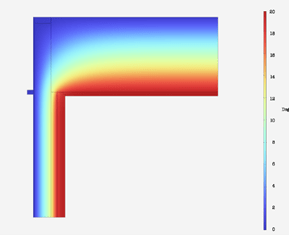
One of the most confusing elements of SAP for clients is the Thermal Bridging, this article explains what they are, what input goes into SAP, and why they are so important.
What are Thermal Bridges in SAP?
In simple terms, a thermal bridge, or heat loss, occurs when two thermal elements are joined together. It’s the join between them that is where the heat loss occurs.
Picture the join between a cavity wall and the roof, ideally you want to the insulation in each to overlap, so there is continuity of insulation and therefore as lower heat loss between the two elements as possible. When they don’t, heat escapes more easily, leading to higher energy consumption and reduced thermal performance.
In SAP, we must account for that heat loss between the two elements, and that heat loss is determined by a psi (Ψ) value, which measure linear thermal transmittance in W/m·K — similar in concept to U-values, but specific to junctions.
Input into SAP
To input this into SAP we measure the lengths of all the applicable junctions and input those, we then apply a psi value to each of those lengths. The software will multiply the psi values by the lengths of each junction to overall Y-value — the total linear thermal bridging effect on the dwelling.
Where does the psi value come from?
In SAP there is a default option, but if these were used with all the different junctions the overall calculation would fail.
Therefore, some can be default values, the less common junctions, but those around the windows, the ground floor to external walls, roof to external walls to name a few, must be from an approved source.
This approved source can be from the insulation manufacturer – Celotex, Actis, Kingspan etc have many examples and if they match the proposed construction then they can be used.
However, if none can be found, and this happens a lot especially with a timber frame construction, then usually the only option is to have bespoke psi values undertaken.
The good thing about bespoke psi calculations is that they are the most accurate, so the results will be more representative of the actual construction and are often better than the off the shelf versions from the manufacturers.
There are also a couple of websites that we use that the proposed construction is input, and the appropriate psi value is given, this is free and we can often use this to match to a proposed construction, but its only for masonry constructions.
So why are psi values and thermal bridging so important?
The Thermal Bridging input into SAP does affect all 3 of the main compliance metrics:
- Dwelling Emission Rate (DER)
- Dwelling Primary Energy Rating (DFER)
- Dwelling Fabric Energy Efficiency (DFEE) .
It’s the DFEE that I am most concerned about as the other two are affected by all the SAP input. The DFEE is only affected by the thermal envelope and ventilation inputs, as the title would suggest. Therefore, if the U Values, the air test target and the ventilation are all at a good design level, and we have the appropriate details for this, it’s the thermal bridging that can be the issue.
As I said, the DFEE won’t pass using all the default psi values, in most instances anyway, so establishing the correct psi values as early as possible in the design process is key. If these are left until the end and the final certification it can mean costly delays or the need for expensive retrofits.
For more information I’ve written a training pack on thermal bridging which can be purchased here
Need help getting your SAP calculations right the first time?
Get in touch with Energy Saving Experts – we’re here to make energy compliance simple and stress-free.
We have written a complete Guide to Thermal Bridging, SAP and Part L and its FREE. email us for your copy